The Golden Era for Manufacturers
A dinner in London in 2013, and a problem no software could solve at the time.
London, 2013
Decades ago, a consultant named Keith Oliver was working a logistics and production planning problem for Philips. Manufacturing, marketing, distribution, sales and finance were each optimizing against their own targets, and in doing so creating inventory, cost and delay for one another. Manufacturing wanted long runs and large batches. Marketing wanted variety and responsiveness. Each performed well against its own target while the enterprise absorbed the cost of the conflict.
He proposed treating the flow of goods as one process rather than a series of separate handoffs. The idea needed a name, and he gave it one: supply chain management.
In 2013 our co-founder Sunil Soman had dinner with him in London. A supply chain question for a large manufacturer was on the table, and Sunil set out the definition of the discipline that most practitioners would still recognize today.
Take a manufacturer. Organize the flow of goods from suppliers, through plants, through distribution centers, to the customer. Configure that network. Optimize it. Set the policies that govern it, stocking, replenishment and service, so that customer service goals are met at the lowest possible cost and the least cash tied up in working capital.
The definition offered that evening
It is a fair definition, and the one most people would give. Oliver’s reply was that this is the smaller problem.
The harder problem
The bigger problem was never the configuration of the network or the movement of goods. It was the alignment of functions: marketing, sales, manufacturing, operations and procurement, behind a single set of enterprise goals.
Functional silos persist because they are rational. Each group optimizes the metric it is held to, and does it competently.
Lowest landed cost
Which can arrive as six months of extra inventory nobody asked for.
Lowest cost per unit
Which can arrive as long runs of the wrong product mix.
Never miss an order
Which can arrive as expedited freight nobody budgeted.
Each of those objectives is legitimate, and each is pursued by capable people. They also work against each other structurally rather than occasionally: the procurement saving that arrives as six months of extra inventory, the high factory utilization that arrives as the wrong product mix, the service promise that arrives as expedited freight nobody budgeted.
His conclusion was that this is a harder problem than any software, policy framework or tool then available. Alignment depended on leadership, on the right leader holding the functions together. Absent that, the silos win.
What changed
Not optimization. The algorithms have existed for decades. They were never the missing piece.
What was missing was coordination: the ability to hold every function’s objective in view at the moment a decision is made.
That is now possible. A procurement decision can be weighed at the same time for what it means to cash, to plant load, and to the customer whose volumes depend on that material. Not because the procurement manager was unwilling to consider those things, but because no person working inside one function can hold all of them at once. It is a limit of bandwidth, not of willingness. What closes the gap is AI that carries the context: the contract terms, policies and operating knowledge that never made it into a system.
The functions do not need to be reorganized. They need the consequences of their decisions in front of them.
Remove that constraint and the procurement manager can make a balanced decision, aligned with manufacturing, legal and commercial. This is why we believe the golden era for manufacturers is only beginning.
What that conversation started
That conversation shaped what came next. Within months, InsightsHIGH was founded to work on the problem.
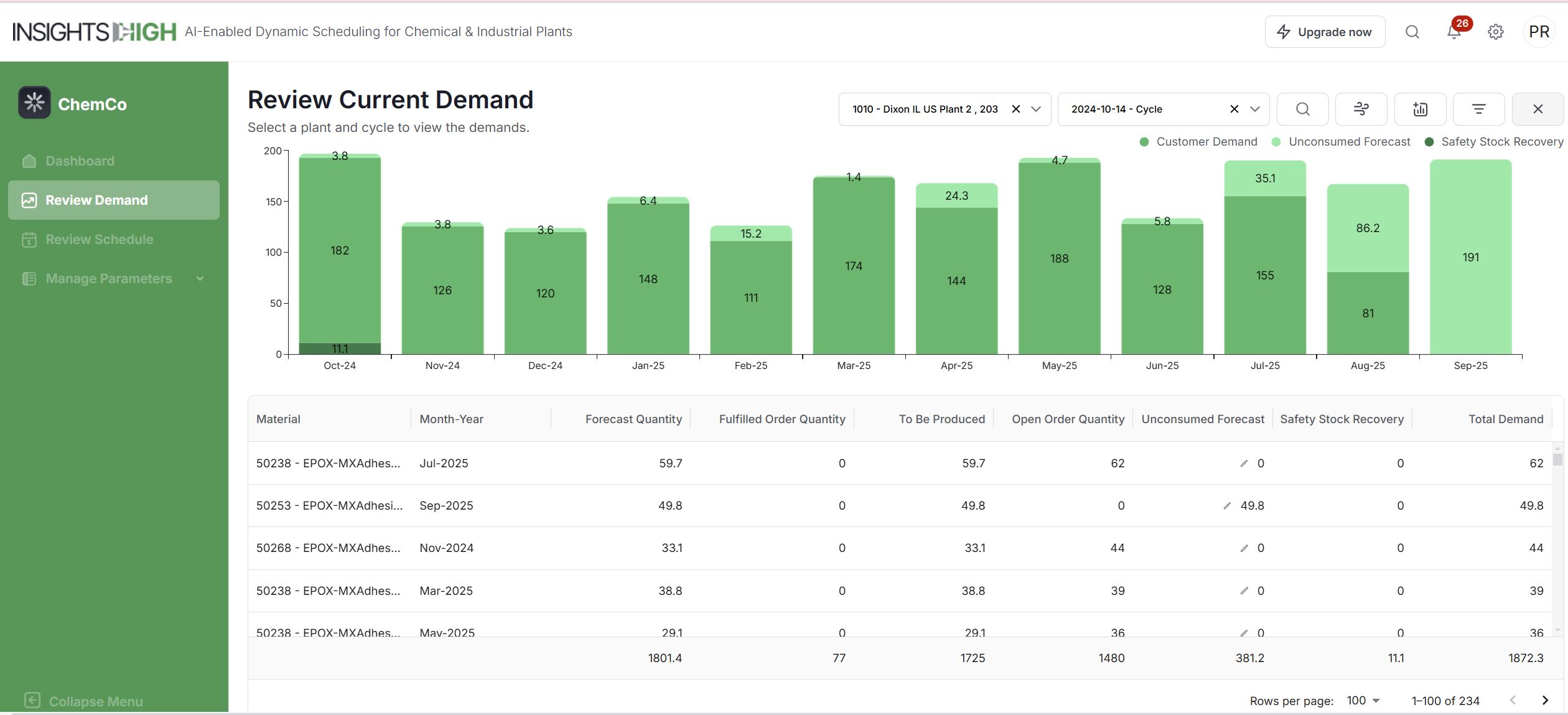
Thirteen years of strategy and operations work followed, across more than 70 transformation initiatives, done by hand in real plants against real P&Ls. A substantial share of it for private equity sponsors and the manufacturers they own, where the same disciplines have to hold up across several companies rather than one. That work is the foundation of Runes AI, and it is why our applications report in revenue, cost and working capital rather than in functional metrics.
The founders
Runes AI is the culmination of the life’s work of two founders who came to AI through the functional problems rather than the other way around, and it is built by the team they have grown around it.
Sunil Soman
Sunil started on the shop floor at Philips, then spent six years in commercial and product leadership at Blue Yonder, where he helped architect supply chain optimisation solutions still used by major manufacturers today.
He then spent seven years at McKinsey and Booz leading performance transformations across commercial excellence and supply chain for clients across the manufacturing industry. He holds formal training in optimisation AI and statistical methods, and two US patents in scheduling and network optimisation.
The product design starts from watching well-built pricing and planning solutions go unused because they did not fit how the team actually works.
Prash Pokala
Prash led complex data-driven technology initiatives at United Airlines and Expedia. Her focus is what it takes for technology to be adopted rather than merely deployed.
At that scale, a data product that is not intuitive does not survive contact with real operations. That discipline shapes every deployment here, and adoption is designed for from the first day of use.
The difference between a solution that sustains value and one that does not usually comes down to workflow design rather than modelling.
Every engagement is led by a principal with direct experience in the area, and there is no handoff to a junior team once the proposal is signed.
What this commits us to
We are building what software could not do before.
If that problem is familiar in your business, we would like to hear how it shows up. Early partners shape the roadmap.