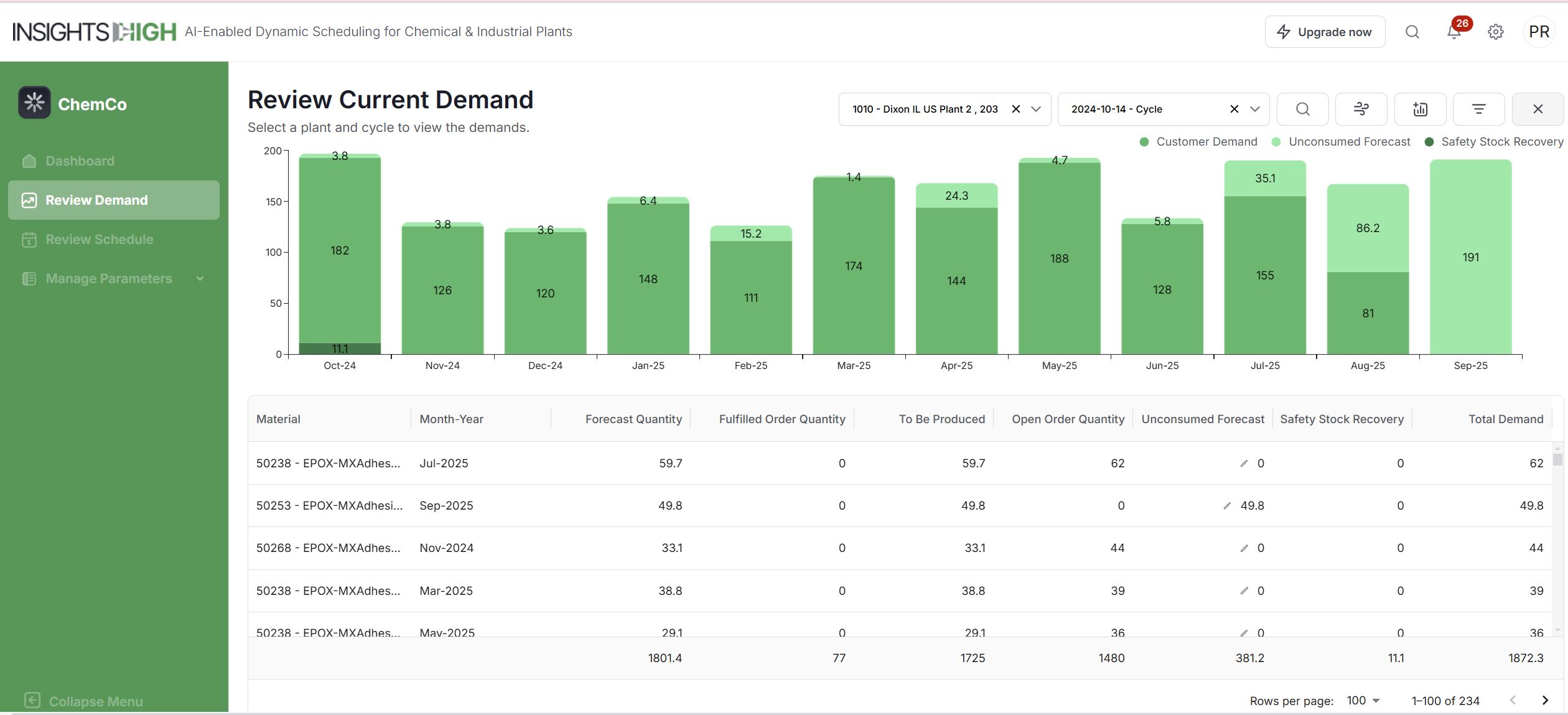
Plant Scheduling
Every stage and every asset sequenced together rather than one stage at a time, traded off against contribution margin, and re-solved when the day changes.
What the application does
Signs you need this
The schedule is built in a spreadsheet by one or two planners, and the logic for building it lives in their heads. When they are away the plant runs on last week’s plan. When they retire, there is no alternative.
You know changeover hours are high and cannot say how far off the achievable minimum they are, so there is no target to manage against.
You have invested in a planning system, and the monthly plan the planners hand to the scheduler is set aside as soon as the meeting ends, because it does not reflect what is operationally possible.
Every disruption starts a manual replan. An asset trips or a batch goes on hold, and the recovery plan is whatever can be assembled in the next hour.
Sales asks whether an urgent order can be accepted and gets a judgment call rather than a costed answer. Commitments are made without knowing the changeover and displacement cost.
Scheduling science is settled. Everything around the solver is not.
Solved to a provable optimum
Constraint programming with decomposition for the campaign layer, solving to a provable optimum inside the model rather than applying heuristics.
Constraints that live in documents
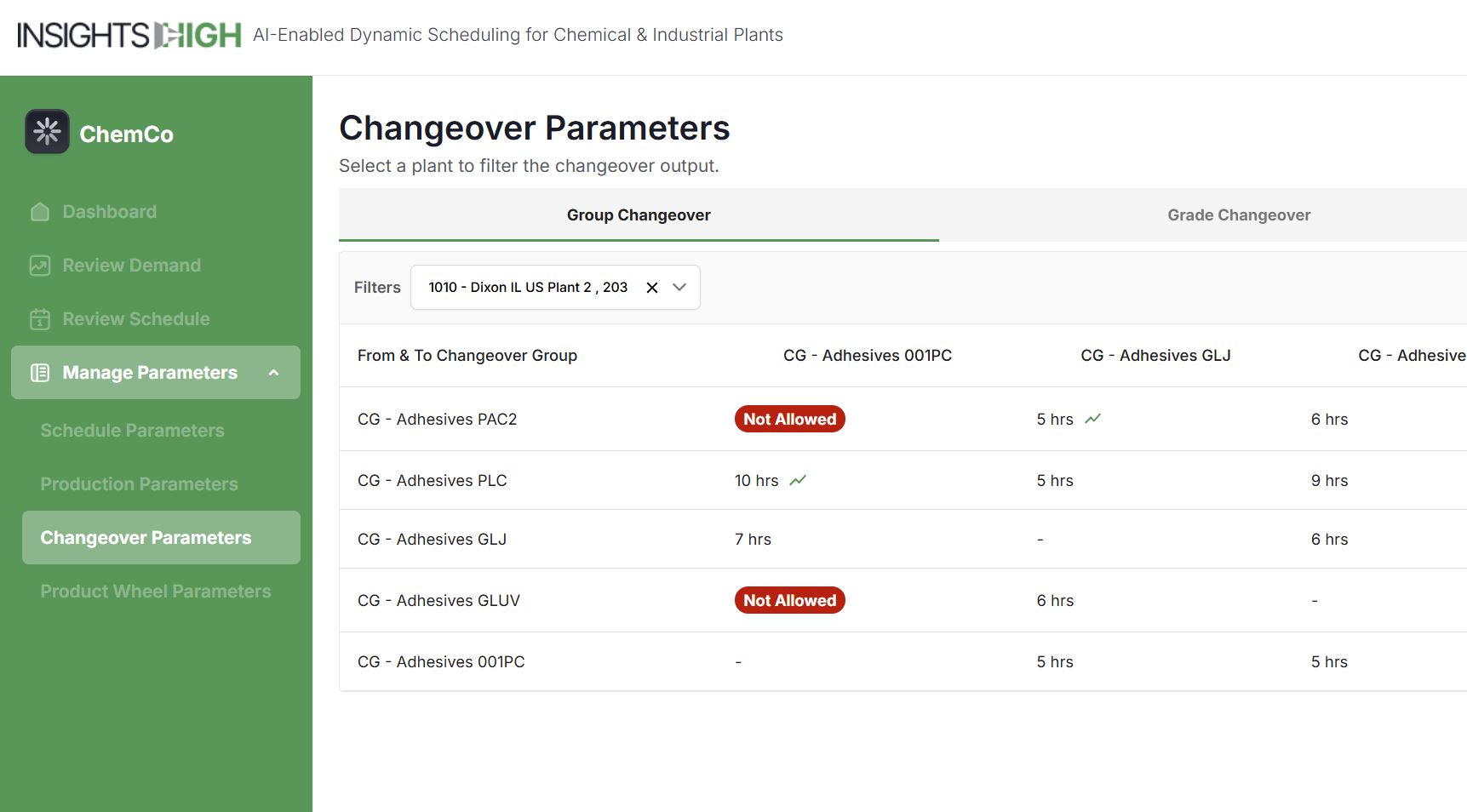
Cleanout and changeover matrices sit in standard operating procedures. Sequencing rules, silo dedication, tank heels, change-control restrictions and customer quality agreements sit in documents. These are extracted into a machine-readable constraint library and a graph of assets and materials. It is the difference between a schedule that is feasible on paper and one planners will actually run.
Rejected once, not twice
When a planner changes the optimized schedule, the stated reason is captured and mapped to the constraint the model was missing. After the same override repeats, the agent proposes a permanent constraint for approval.
State the intent, see the consequence
A planner states the intent in plain language. The co-pilot translates it into constraint changes, re-runs the optimizer, and returns the impact in changeover hours, margin and commitment conflicts before anything is confirmed. No parameter screens, and no overnight batch job.
A response before anyone reports the problem
Plant and order signals are watched continuously. Where the plant floor system is connected, an asset going down triggers the re-solve without waiting, and the recovery plan arrives with the displaced orders and the tradeoffs named.
See it against your own constraints.
A thirty-minute discovery call, including a demo of the application and what it would take to run it on your plants.